Wednesday, 17 April 2019

NOTRE DAME CATHEDRAL : A RECOLLECTION


It is unfortunate that the iconic Notre Dame cathedral in Paris stands ravaged by a massive fire. It is not only a place of worship especially for the Catholics but also a major historic site. It is, of course, a great tourist attraction.  I feel nostalgic, as I have been there twice.  I have also devoted one chapter in my book "Marvels Very Majestic" to the cathedral.  Here I present a few of its rare features.


WHERE RELIGION AND HISTORY MEET
(By Subbaram Danda)


The cathedral two decades ago

Notre Dame means “Our Lady” in French.  It is an “active Catholic church” dedicated to Virgin Mary containing the “Cathedra,” the official chair of the Archbishop of Paris. It is located on a small island in the river Seine at the centre of Paris. Besides attracting a large number of tourists every year, it finds a prominent place in several movies. 

Strangely, as if jinxed, the Notre Dame cathedral has gone through periods of destruction and renovation in its centuries of history.  During the French Revolution it was plundered and misused as a warehouse.  Many statues were decapitated or mutilated.  For years it remained neglected. Celebrated French Writer Victor Hugo, through his famous novel “The Hunchback of Notre Dame,” whipped up the sentiments of Parisians and made them see the need for its restoration.  The consequent major renovation brought the cathedral back to its old form. During both the world wars it was subjected to shelling, but it survived. 

The cathedral's architecture is marked by ribbed vaults, pointed arches and towering columns. It is specially known for its stained glass windows and admirable sculptures. 


A stained glass window  (Photo courtesy: WhatsApp)

Even the cathedral’s beginnings were chequered. The cathedral was constructed on the spot, where the Romans had earlier built a temple for Jupiter centuries ago.  This was followed by a basilica and then by another church. The foundation for the present shrine was laid in 1163 AD but its progress was intermittent.  It was not completed until 1345 – a delay of about 180 years.  A succession of architects and changing plans made this edifice an amalgam of styles.

The cathedral was the venue of several public events.  It was here that Napoleon Bonaparte demonstrated that the state enjoyed supremacy over the church and crowned himself the emperor.  In dramatic sequences, he took the coronation oath, collected from the alter the crown already blessed by the Pope and personally placed it on his head.  He them laid the diadem on the head of his wife Josephine.  Subsequently, official heralds proclaimed Napoleon the Emperor of the French.

On another occasion, when Paris was liberated during the World War II General de Gaulle rushed to the cathedral to offer his thanksgiving prayers.  His state funeral was also conducted there.


The devastating fire engulfing the cathedral
(Photo courtesy: WhatsApp)

There is another feature of the cathedral that is very fascinating.  In front of its main entrance at a distance of about 100 feet there is a small octagonal brass plate set in the ground.  Engraved on a surrounding circular granite slab is a legend "Point Zero -- Des Routes de France."  It marks the starting point for measuring all distances in Paris.  

Over the years, this "Point Zero" has acquired a mystic aura and become a "good luck" charm. People place their palms on the plate or spin with one foot on it making a wish.  Some couples even stand together on it and kiss seeking eternal bliss.  

April 17, 2019


Wednesday, 3 April 2019

JABALPUR : THE MAJESTIC NARMADA


An evening boat-ride on the Narmada river was the highlight of our visit to Jabalpur in the last lap of our Madhya Pradesh tour.  It was altogether a different experience.  The boat sailed past tall marble hills on both sides of the river.  It was a pleasure watching the mountain cliffs change their shape and colour, as the sun-rays played hide and seek with them.  Another attraction nearby was the waterfalls, where the Narmada cascades amidst a canopy of mist.


The Narmada flows flanked by marble hills

THE RIVER AND THE ROCKS
(By Subbaram Danda)

It was a long drive from Khajuraho to Jabalpur and then to Bhedaghat, a village, where the boarding point for the boat-ride was located.  From the road we had to walk down a long-winding flight of broad concrete steps.  On both sides, shops sold a wide variety of marble artefacts. At the ghat, boats had lined up one jostling against another.  They were all of rowing type.  Motor boats were not allowed to operate from there for ecological concerns. We engaged an entire boat for our group.  It was sturdy and fairly comfortable.


Sailing on the Narmada

Two men rowed the boat, one of them singing Hindi songs and poems full of alliterations.   It served to explain the features of the mountains and the river as the boat sailed along.   His knowledge looked impeccable. He would break out of the song to point to interesting formations among the boulders.  There were rocks resembling an elephant foot, a deer and the horns of a cow.  He would gesture at marble layers of light pink here and mild green there.

In the boat with group members

We kept clicking selfies and photos of rare-looking rocks.  “Let not the still waters of the river fool you.  The river is 600 feet deep here,” the oarsman drew our attention.   Suddenly he asked us in a high pitched tone to take a look at a boy perched on top of a high hill.  The urchin was ready to dive into the river, if we could pay him.  We were not for it, as we were not sure whether it would be a safe feat. Such daredevilry was a regular occurrence all along the route, he said with a mischievous smile on his face.

A boy perched on a hill ready to dive into the river

As the boat moved forward, at a particular spot he put out his left hand pointing to a boulder and said that marble slabs made out of it were better than Italian ones. In fact, any kind of marble available anywhere else in the world could be found there, he added with a touch of self-importance. The quality and variety of the marbles were top-class.  

Appreciating the narrative of the oarsman

The oarsman took pride in telling us that the Narmada and the marble rocks provided an excellent backdrop for shooting scenes for a few Bollywood films.  The hit song “Raat Ka Nasha” was picturised here for the Kareena Kapoor starrer Asoka.  An outdoor fighting sequence for the flick Mohenjo Daro was also canned at Bhedaghat.


A dance sequence for the movie Asoka was shot at Bhedaghat

Soon we arrived at a point where the mountain ranges on both sides of the river appeared to come closer.  It was named Bandar Kodini, meaning a spot for monkeys to jump from the cliffs of one side to the opposite ones.  As the sun cast long shadows, we turned back heading towards the boarding point.  We could see the rock formations in different diffused colours. The entire boat-ride clocked one hour.

It was an hour-long boat journey 

On the way to the road, we spent a few minutes closely watching the marble articles sold in the shops.  What astounded us was display of huge marble Shiva lingas as tall as four feet.  Small ones were also there.  Other artefacts on show included ornamental idols of deities, jars, lamps and name signs. At a stall we could see an artisan turn a rough marble block into a decorative elephant. His casual style of working was amazing.  

Shops selling marble articles

Our drive from Bhedaghat to the falls area was short. Called the Dhuandhar Falls, it is where the Narmada plunges to a depth of about 95 feet in a horse-shoe format.   A cable car from the parking lot took us over rocky terrain through which the river flows till the point of the falls.  It could also be reached overland.  Men, women and children in large numbers were there enjoying the roar of the falls.

The Narmada plunging to form Dhuandhar Falls

In monsoon times, the horse-shoe-shaped cascade would look gorgeous like the Niagara in its miniature form, we were told.  But when we were there, the water in the river was not much and so there were breaks in the cascade.  Still it was beautiful, if not spectacular.  We spent quite some time appreciating the falls and the scenery around.

At the Dhuandhar Falls 

The Bhedaghat boat-ride on the Narmada and the Dhuandhar waterfalls will remain green in our minds for long.

(The series has concluded)

April 03, 2019

Saturday, 30 March 2019

KHAJURAHO REVISITED


The splendour of the sculptures of the 1,000-year-old Khajuraho group of temples in Madhya Pradesh attracts a large number of tourists from all over the world right through the year. These creations in stone celebrate human life and emotions in all their myriad forms and in shocking styles.  They are unparalleled in the history of world art and architecture.  For me it was a refreshing revisit last month.  For my wife it was her first trip.


PASSIONS CREATED IN STONE
(By Subbaram Danda)


As we entered the vast temple area, we could see ahead of us neatly mowed lawns, well trimmed hedges, blooming flower plants and the towers of a few temples.  It was a delightful sight.  Originally, there were as many as 85 temples in three clusters but only 22 of them have survived the ravages of time and human intolerance. Nowhere in the world can one see so many temples grouped together at a stone’s throw from each other as in this complex.   Most of them are dedicated to the gods of the Hindu pantheon and a few to the Jain faith
.
At the entrance to the Khajuraho group of temples

The name Khajuraho is derived from the Sanskrit word ‘kharjur’ meaning date palms, which are abundant in the area. The temples were built by kings of the Chandela dynasty between 950 AD and 1050 AD, when their reign was at its peak.

The origin of the Chandela dynasty is steeped in mystery.  According to a legend, a young widow of ravishing beauty was swimming in a pond on a full moon night when her charms attracted the Moon god.  He descended to earth and paired with her.  To atone for his act, he granted her a boon.  Accordingly, a son of great valour was born to her, who was named Chandravarman after the Moon god.  In course of time he became a king and established the Chandela dynasty.  As desired by his mother, he took up construction of temples.  An emblem, crafted in stone, where a warrior takes a lion head on, had been the royal symbol of the dynasty, reflecting the bravery of the Chandela kings.  This emblem can be seen at several spots in the temple complex.

The emblem of the Chandela kings

Each temple at Khajuraho has its own distinctive features.  The Kandariya Mahadev temple in the western cluster stands out as the largest and loftiest.  Dedicated to Shiva of the Hindu Trinity, the temple’s principal tower rises to a height of more than 100 feet.  It is said to resemble Kailash, the celestial abode of Shiva.  It displays sculptures of gods, goddesses, celestial nymphs, sensuous acts and animals on its walls, pillars, brackets, recesses and at every conceivable place.  One expert has counted 226 statues inside the shrine and 646 outside. A number of them are as big as two-and-a-half feet to three feet in height.


At the Kandariya Mahadev temple

One other temple that is spectacular in this sector is the Lakshmana temple, dedicated to Vishnu, another God of the Trinity.  It is not clear how this shrine has come to be known as the Lakshmana temple.  It is the earliest and the best preserved temple of the lot.  Realistically chiselled elephants at the base give the impression that they are supporting the temple.  It also has fine specimens of bracket figures.


At Lakshmana temple with group members

At the Vishwanath temple, the basement niches are carved with Saptamatrikas, Ganesha and Virabhadra.  Inside, the main hall and the passageway contain some of the loveliest sculptures, including a woman with a fruit in one hand and a parrot in the other, a mother with her child, a damsel playing the flute and amorous couples. 


At Vishwanath temple

The Varaha temple is relatively small in size.  But, it enshrines a colossal monolithic image of Varaha, the boar incarnation of Vishnu. It is nearly nine feet long and six feet high.  An astounding feature is that all over the body of the boar 672 figurines of Hindu gods and goddesses have been etched.

At Varaha temple

Among the Jain shrines, the Parsvanath temple in the eastern sector is the most appealing. Lavishly carved statues can be found on its outer walls. Some figures like a lass writing a letter, a dancer wearing an anklet, a woman extracting a thorn from her foot and a damsel using an eye-liner are very popular.

A maiden using an eye-liner

The erotic figures, seen in almost all the temples, evoke varied reactions in the visitors. While some feel quietly embarrassed, a few turn away with suppressed giggles. What has really perplexed researchers of Khajuraho’s erotica is its unabashed boldness, unparalleled variety and startling size.  Interestingly, only ten per cent of the total sculptures fall under this category.  A British author has described the amorous sculptures as representing “the apogee of the erotic art in India.”  Why are the sensuous sculptures present in a place of worship, where a person goes to acquire purity of thought and peace of mind? It is explained that ancient treatises on temple architecture do permit them for purposes of “ornamentation, prosperity and protection from evil spirits.” There is also a view that the Chandela kings followed the Tantric cult, which encouraged gratification through sensuous pleasures for attaining liberation from earthly bonds and ultimate eternal bliss.  There are some other theories but they lack conviction.

Sculptures on the wall of a temple 

These temples also serve as a spectacular backdrop for an annual week-long dance festival organized by the Madhya Pradesh Kala Parishad towards the end of February, when the harsh winter gives way to the warm spring.  The fete has been inspired by the legendary dances of Shiva Tandava (cosmic dance) and Krishna’s Raasleela (dance with companions).  It is held in an open air auditorium within the temple complex in the evenings as the shrines glow in colourful lights.  It is a great platform for classical dancers from all over India to showcase their talents and present innovations. 

The annual dance festival in an open-air auditorium

We watched the dance programme on the evening of February 26. In fact, it was a highlight of our trip.  Our tour organizer had thoughtfully incorporated it into our itinerary.  An Art Mart, where handicrafts made by people in and around the state are exhibited and sold in colourful tents, is a popular adjunct. Marble icons, metal-ware, textiles and wooden artefacts are a big draw. 

At the Art Mart

My current visit to Khajuraho is one of rediscovery. It is heartening to note that the UNESCO-recognized world heritage monuments are being maintained with care and attention. One must see them at least once in one’s lifetime.

(The series will continue)

March 30, 2019

Saturday, 23 March 2019

ORCHHA : HISTORY AND MYSTERY


At Ram Raja temple in Orchha, Madhya Pradesh, a strange ritual takes place every day. The deity gets an armed salute from a policeman in uniform four times a day.  Stranger is the story of the origin of the temple. Unique mansions and memorials add more colour to this historic town.


WHERE GOD IS KING TOO
(By Subbaram Danda)

Aerial view of Ram Raja temple
(Photo courtesy: temple website)

Orchha is a quaint town in Madhya Pradesh with a population of hardly 12,000.  But it is very famous for the Ram Raja temple, which has an incredible history.  Here Ram is revered not only as God but also as a king. The sanctum is located in a palace but not in a traditional type of temple.  The deity receives all royal honours, including a salute from a rifle-armed policeman four times a day, as the doors of the sanctum open and later close – in the morning and the evening.  Unlike other temples in Orchha, Ram Raja temple gets painted in cream and light orange hues regularly in keeping with palace practices.

A policeman armed with a rifle saluting the deity
(Photo courtesy: temple website)

This unique temple has a mystical origin.  According to a legend, a queen of Orchha, being an ardent devotee of Ram, took up a challenge posed by her Krishna-worshipping husband that he would heed her request to construct a temple for Ram if she brought Ram in human form from Ayodhya. In all earnestness, she went to Ayodhya and meditated for long on the banks of the Sarayu river.  Pleased with her prayers, God Ram appeared before her and agreed to come to Orchha with her as a baby boy.  However, he laid down a few conditions. One was that the first place in Orchha where the baby would stay would be the place from where he would vanish leaving behind an idol for consecration. The second was that Ram should also be treated as the king of Orchha and all royal honours should be accorded to him as well.  The Queen agreed.

Meanwhile, the king became enlightened and started constructing a building for the Ram temple.  But when the queen returned to Orchha, the building was not ready and so the queen and the baby stayed in the royal palace.  As stated, the boy vanished from there, leaving behind an idol of Ram. Interestingly, the idol could not be shifted from there.  So the palace was converted into a place of worship.  Since then this palace-turned-temple has been a great attraction for devotees.

Ram Raja temple in the background

During our visit to Orchha, we went to the temple to witness the evening aarti.  People had thronged a very spacious quadrangle in front of the sanctum.  Our guide took us to a vantage point from where we could have a good view of the sanctum, which was then closed. We could see a policeman standing near the doors holding a rifle.

At the appointed time, as the doors opened to the holy chants of the devotees, the policeman came to attention and saluted the deity with his rifle.  The priest proceeded with the aarti ceremony and the devotees filed past in two lines with folded hands taking a look inside.

Our guide drew our attention to the fact that the idol of Ram in the sanctum is in a sitting posture with the left leg resting on the right thigh.  There are also some other idols besides those of Sita, Lakshman and Hanuman.

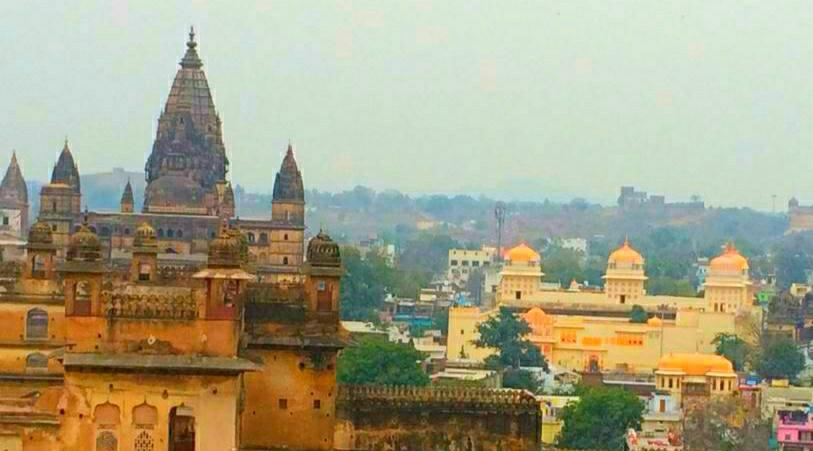
The unfinished temple, which was originally intended for Ram, was also completed subsequently but it retained the name of Chaturbhuj mandir, meaning a temple for the four-armed deity Vishnu in his incarnation as Ram.  However, it remained without a deity for a long time.  Today, the principal deity worshipped there is Radha Krishna.

Chaturbhuj temple (left) and Ram Raja temple (right)

Chaturbhuj temple

River Betwa, a tributary of the Jamuna, flows through Orchha.  With greenery and scenic spots all around, the town has been an ideal location for putting up mansions.  The river finds mention in epic Mahabharata and other religious texts as a venerable river.


River Betwa flows through Orchha

An outstanding building that tourists visit in Orchha is Jahangir Palace, whose main portal displays intricate artworks with turquoise tiles.  Stone sculptures of elephants on either side of the doorway greet the visitors. Interiors of the three-storey structure are marked by open courtyards, hanging balconies, creative lattices, varied porches and innumerable chambers.


The main portal of Jahangir Palace

Inside Jahangir Palace

Jahangir Palace was built in the 17th century by the Rajput Bundela ruler Bir Singh Deo to commemorate his friendship with the Mughal emperor Jahangir.  How it all happened is intriguingly interesting.  Generally, Bundela kings had been antagonistic to the aggressive designs of the Mughals. When Akbar was the emperor, his son Jahangir proved highly rebellious and belligerent.  In a clever move, Bir Singh Deo, who was only a prince at that time, befriended Jahangir and foiled a plan of Akbar to kill Jahangir. Eventually when Jahangir ascended the throne, the friendship between the two got cemented further.  He in turn helped Bir Singh to come to power with ease and consolidate his regime. 

Nearby stands another edifice -- Raja Mahal, which was the place of residence for some royal generations of Orchha.   Its exterior is simple but the interior is rich in architectural designs. The murals in some chambers are outstanding with depictions highlighting events in Hindu epics and portraying royal amusements and folklore.  Its layout is such that sunlight entering the palace causes different shades and temperatures at different points so that the inmates would remain mostly in high spirits. It has several secret passages.

Murals in the Queen's chamber of Raja Mahal

Murals in the public hall

Visitors to Orchha cannot fail to see many cenotaphs.  They were built for the kings and their kin.  Most of them look alike with a tall tower at the top in the centre and domes at four corners of the building.  They came up at spots where the royals were cremated. The architectural pattern of some other cenotaphs is somewhat different

Cenotaphs of Orchha royals

With the group travellers at Orchha cenotaphs

Orchha shines steeped in history and mystery and is certainly a town worth visiting.

(The series will continue)

March 23, 2019 


Saturday, 16 March 2019

JHANSI : WITNESS TO AN ERA


Ever since I watched the movie “Manikarnika: the Queen of Jhansi,” a curious desire was growing in me that I should visit Jhansi and see for myself at first hand the famous fort there, which was the scene of a mighty battle. It was a surprise for me that the desire was fulfilled sooner than expected, when the group tour came my way. From the fort the young brave warrior queen fought a fierce battle against the British forces.  When victory eluded her, in a daring feat she escaped jumping from the top of the fort on horseback with her adopted kid tied to her back.
 

 THE TALE OF A HISTORIC FORT
(By Subbaram Danda)


In front of the historic Jhansi fort

We drove to Jhansi from Gwalior.  It was evening.  We wound our way up a hill to reach the fort.  Our excitement ran high, as the fort came into our view.  On the left we could see a rugged high wall of the fort and on the right the city spreading out all over below. Ahead was the entry gate.  We got down from our cars and our trek began. 


A park adjoining a wall of the fort

The city of Jhansi spreading out below the hill-top fort

We ambled over long ramps, moved along maze-like walkways and trudged up steep staircases.  We went past cannons, large barren rooms, cavernous closed spaces, vacant mansions, disused garrisons and some parks.  We clicked photos and selfies, even as our tour guide waxed eloquent on the citadel and the gallantry of the queen of Jhansi.   

On the top terrace of the fort

A park in the fort premises
The fort was built in the 17th century by a ruler of the Bundela dynasty Bir Singh Deo.  Standing on a steep hillock it measures 1,000 feet in length and 750 feet in width.  With 22 bastions, massive fortification walls made of solid granite blocks of 15 to 20 inches in thickness and moats on two sides, the fort looks impregnable.  Ten gates, strategically located, provide access to the fort.  

The fortification walls

A typical bastion of the Jhansi fort
Manikarnika was the maiden name of the queen of the princely state of Jhansi.  She was popular with the people through her good deeds and earned their admiration and support.  During the Indian mutiny, also known as the First War of Independence, she led Jhansi forces and fought the British heroically.   

At another spot in the fort

With group members
In due course, when the British forces were all set to overtake the fort, Rani Jhansi figured that at any cost she should avoid being captured.  Under the cover of darkness in the night she rode over ramps to the top of the fort on her favourite horse Badal with her adopted kid tied to her back.  On the long terrace she galloped till she reached a chosen corner.  In a swift daring act she prodded the faithful and well-trained horse to jump off the parapet wall into a ravine deep down below.  She and the kid survived the steep fall but unfortunately the horse died.  With a heavy heart she managed to escape to the town of Kalpi helped by some guards, where she again fought the British forces.  Defeated there also, she eventually moved to Gwalior, where she attained martyrdom.  In the Jhansi fort, the spot from where the queen jumped off on her horse back has been a site of great tourist interest.  A board proclaims the valiant act of the young warrior. 


This is undoubtedly a unique fort that bears witness to acts of valour of a different kind..

(The series will continue)

March 16, 2019