Saturday, 12 May 2018

THE HIMALAYAN QUEEN


The Himalayan Queen -- it is a romantic name given to a train running on a mountain track between Kalka in Haryana and Shimla in Himachal Pradesh.  The entire route is mesmerizingly scenic.  You will remain awe-struck from the very moment the train leaves the station, chugging arduously up and up. 


The scenic route of the mountain railway


UP AND UP IN A TOY TRAIN
(By Subbaram Danda)


We travelled to Kalka from Chandigarh, a distance of 30 kilometres, by taxi to catch the Himalayan Queen heading to Shimla. It left the station at 12:10 p.m.  We chose this mode of travel for the laidback convenience that it offered.   As it picked up speed and pulled up and up, it was sheer pleasure watching hill settlements, deep valleys and distant mountains pass by.      

Also known euphemistically as the Toy Train, it trudges along languidly on a narrow gauge.  It takes as many as five and a half hours to reach its hilly destination 96 kilometres away.  The rail-line, more than 100 years old, has the World Heritage tag given by the United Nations Educational, Scientific and Cultural Organization (UNESCO).

The Toy Train negotiates a sharp curve

It is different from other trains in several respects.  Each compartment is small with just 30 seats and not connected to others through a vestibule passage.  No wonder, it is called a Toy Train.  Therefore, food is not served in the train. Following a piece of advice from a canteen waiter at Kalka, we carried some packed snacks to see us through till we reached the destination. 

It is entirely a chair-car train with a total of seven compartments.  It is not air-conditioned.  So we could keep open the glass windows for a clear view of the scenery outside and also take photos. 

In the compartment

The rail-line was laid during the British Raj for the then rulers to come to Shimla for their summer retreat.  Its operations commenced during the days of Lord Curzon in November 1903.  It was considered the “crown jewel” of the Indian National Railway.

The track passes through 102 tunnels and over 800 bridges and viaducts.  One tunnel is more than one kilometre long.  Some bridges look like ancient Roman aqueducts with an array of multi-storeyed arches.  More than two-thirds of the track is curved, sometimes at angles as sharp as 45 degrees. 

Roman aqueduct-like bridge with multiple arches

The train’s movement was fascinating.  It began its climb upwards almost immediately after it left the Kalka station, which is at an altitude of 2,150 feet above sea level.  In just 40 kilometres from Kalka, it was moving at an altitude of 5,200 feet -- a mind-blowing climb of 3,050 feet!   Interestingly, for the passengers it was almost imperceptible.  By the time it reached Shimla it had climbed a total of 5,320 feet vertically so to speak. 

We had booked our seats on the first day when the online reservation window opened.  We were given one window seat and the next one on the right side of the compartment, said to be the best side for watching sceneries outside while heading towards Shimla.

A scenery on the way -- two parallel roads

A hill-side settlement

Whenever the train passed through a tunnel, children in a compartment before ours gave out shrill cries, enlivening the journey.  When the train passed through the one kilometre long tunnel, it was a continuous hilarious hooting.   It was an experience!

Less than half way through, we could feel chill breeze from the hillside enter the compartment and freshen up our faces.  Outside, deodar, pine, oak and maple trees in valleys swayed passionately in the winds in demure sun.  

Hills and valleys with a variety of trees

Apart from getting the UNESCO tag, the rail-line has also entered the Guinness Book of World Records for the steep gradient it continuously negotiates.

It would be better, if the Railway pays sufficient attention to maintaining the compartments spick and span.  Otherwise, the show piece status of the train would vanish into thin air. 

Though there are a few more Toy Trains, the features of the Kalka-Shimla line are outstanding.  We have travelled by a couple of such other trains also but our feeling is that the experience on this route is pleasingly different.  We were told that in winter the scenery en route would be spectacular with snow clad hills and valleys glowing in picturesque splendour.  (Ends)

(Our tri-city sojourn will continue)

May 12, 2018

Tuesday, 8 May 2018

THE CHARMS OF CHANDIGARH


We – my wife and I – were on a tri-city sojourn in Chandigarh, Shimla and Kufri this summer between April 19 and 25, 2018.  Chandigarh is reputed to be a well-planned city.  Shimla is a world famous summer retreat.  Kufri is emerging as a tourist paradise with many modern resorts having come up. It was our first visit to these places. 


An artificial waterfall in the Rock Garden, Chandigarh


THREE GARDENS, A LAKE AND A TEMPLE
(By Subbaram Danda)


Chandigarh was the first on our itinerary.  It is located in the foothills of the Shivalik range of the Himalayas.   Meaning the “Fort of Chandi,” its name is derived from an ancient temple there called Chandi Mandir devoted to Goddess Chandi.

Administratively, it is unique.  While being a union territory, it is also the capital of two north Indian states of Punjab and Haryana.  The first planned city in post-independence India, it was designed by the Swiss-French architect Le Corbusier.  His creation – a giant Open Palm– has become the city’s symbolic icon.

Rock Garden

Though the city has many tourist attractions, the most visited is the Rock Garden spread over 40 acres.  Also known as Nek Chand’s Rock Garden after its founder, it is a garden of colourful sculptures of a different kind -- made wholly of waste materials like broken pieces of porcelain, pottery, rocks, metals, auto parts, wood and bangles.  One can find figurines of dancers, musicians, boys, girls, animals and birds. 

We passed through a maze of lanes and narrow arch ways to see the exhibits.  It is a great open air display of unusual pieces of art.  An outstanding feature of the Rock Garden is an artificial waterfall made possible through diversion of water from a nearby lake.  This is the most sought-after site for photo enthusiasts. We took about a couple of hours to leisurely walk through the whole area.  It is said to clock 5,000 visitors every day.


A sculpture in front of the Rock Garden paying a tribute to its creator

The artificial waterfall in the background

Sculptures of different kinds

Peacocks

Marble pieces extensively used

A gallery of dancers

School boys in uniform

Through long-winding ways

Figurines of men and animals 

Sukhna Lake

Close to the Rock Garden lies a serene water-body called Sukhna Lake, surrounded by lush greenery.  Stretching across 3 km, the lake was formed in 1958 by damming a stream flowing from the Shivalik hills.  Water sporting activities like boating, yachting and water-skiing are prominent here.  There is a children’s play area too.  The promenade on the shores of the lake attracts a stream of joggers and walkers in the morning and evening.

Boats ready to take visitors on board

Serene environment

The palm -- the icon of Chandigarh in the lake premises

Rose Garden

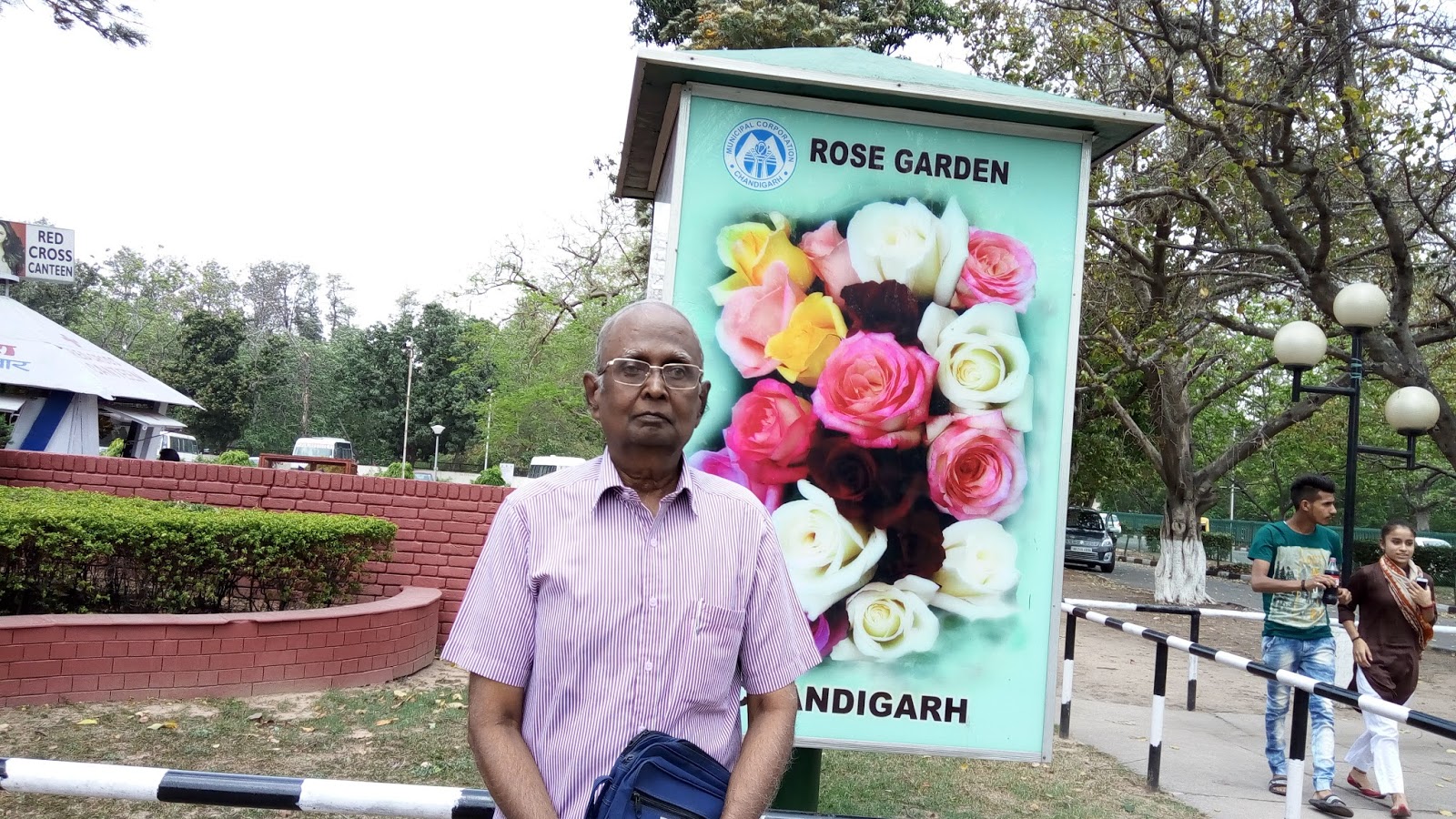
About four kms from the Rock Garden is the sprawling Rose Garden, said to be the largest one of its kind in Asia dedicated to roses.  It is claimed that the garden has more than 32,500 plants, representing 825 varieties of roses.  Named after former President of India Zakir Hussain, it also houses several herbal plants. 

Unfortunately, when we visited, several plants and their flowers were in a state of withering.  However, the vast layout with neatly trimmed lawns and paved pathways was appealing.


A sign in front of the garden

Entering the garden

Withering plants and flowers

Neat benches and lawns

Camel rides outside the garden

Manasa Devi Temple

Our next visit was to a famous temple, set against a scenic backdrop, dedicated to Manasa Devi, a form of Shakti, at Panchkula in the state of Haryana near Chandigarh.  Constructed by Maharaja Gopal Singh during 1811-1815, it is currently administered by the state government.   

The sanctum is accessed by climbing a long flight of stairs.  The temple is so popular that we had to wait in a long queue to have darshan of the Goddess. Huge crowds are said to throng the temple during auspicious days, especially at the time of the Navaratri melas.   


Manasa Devi deity


Outside the sanctum

In the temple complex

Pinjore Garden

Slightly away from Chandigarh lies the 17th century Pinjore Garden.  It is a picturesque site with a long flowing water channel, flanked by paved paths, flower beds, lawns and tall trees.  Different types of pavilions across the channel at intervals add to the grandeur of the whole place. 

Pinjore Garden was created by the foster brother of the Mughal emperor Aurangazeb to serve as a summer retreat for the king.  Far later, it was extended and reconstructed by Maharaja Yadavindra of the then State of Patiala.  At present it is a good tourist attraction.  A children’s play area with various rides outside the proper garden is a special addition.  Camel rides are well patronized.

Immediately after entering the garden

At one of the pavilions 

The long central waterway flanked by paved pathways and lawns

At another pavilion

At the children's play area

There are also some other attractions like International Dolls Museum, Cactus Garden and Art Gallery but we had to skip them for want of time.  We were happy we had covered the important ones. (Ends)

(Our tri-city sojourn will continue)

May 08, 2018


Tuesday, 1 May 2018

RECOLLECTIONS Sweet and Sour - 05


In the last part of this series I wrote about my pleasant and memorable experiences as a journalist.  But it is not roses and roses all the way. In the current piece, I wish to narrate the hardest times I have been through.   


THE TRAVAILS OF EMERGENCY
(By Subbaram Danda)


That morning readers of the “Indian Express” all over the country were at their wits’ end to know why there was blank space where the first editorial of the newspaper should have been.  They were, however, quick to realise that it was the result of press censorship imposed in the wake of declaration of emergency and a critical editorial had been removed.

Thus began the darkest days for the freedom-loving scribes in India.  The trying times lasted 21 long months during 1975-77.

At the behest of the then Prime Minister Indira Gandhi, President Fakhruddin Ali Ahmed declared a state of emergency on June 25, 1975 as “security of India was threatened by internal disturbances” among other developments. It was announced on All India Radio by Indira Gandhi.  The nation remained shocked.

The proclamation bestowed on the Prime Minister overwhelming authority to rule by decree. It saw drastic curbs on civil liberties.  Most of Indira Gandhi’s political opponents were imprisoned. 

Capping it all, the press was censored.  At that time, radio and television were state-owned. It was easy for the Centre to make them toe the line of the government.  Only the print medium was in private hands.

I was a Senior Staff Reporter in the “Indian Express.”  My newspaper was particularly targeted because its owner Ramnath Goenka was a staunch supporter of Jan Sangh, arch rival of the ruling Congress party.  Also, the newspaper was known for its forthright news and views.

As newspapers could not openly criticize imposition of emergency, they devised their own ways of opposing it through sarcasm and ridicule.  On the first day of emergency, the blank space in the editorial page of the “Indian Express” was eloquent enough to inform the readers that the press was gagged under censorship. 

The “Financial Express” went one step ahead.   It carried in its editorial space in large letters Nobel Laureate Rabindranath Tagore’s poem, “Where the mind is without fear, and the head is held high….” The verse concluded with a prayer, “into that heaven of freedom, my Father, let my country awake.” 

Nothing could be more sardonic.   It was powerful enough to convey the yearnings of the people.

Though newspapers were not taken over, they could not question imposition of emergency nor criticize government policies.  Views of opposition parties were a taboo.  The screen plays of films and dramas had to be approved in advance.  Though we were sure that some of our reports would not see the light of the day, we had to type them out and transmit them for the information of the resident editors of all editions.

Our telephones were tapped.  Our movements were watched.  At public meetings and press conferences, which were selectively permitted, we could see sleuths of the Intelligence Bureau in plain clothes mingling with the people.  One such person turned very friendly to me but I could not afford to slacken my vigil!

Country’s economic woes were biting.  A ceiling was imposed on the quantum of dividends that companies could declare.  Our office did not pay our salaries in time.  Our advertisers played hide and seek. We all “voluntarily” agreed to a ten per cent cut in our take-home pay.  

In those days we did not have computers, and news items had to be composed on Lino machines.  Work on “making” pages would start in the evening and would go on till the deadline for each edition. 

Every page had to be cleared by the censor, which was the Press Information Bureau (PIB) of the Government of India located at the Shastri Bhavan in Chennai. 

Imagine the workload on the poor PIB officers.  They had to go through every line of every item, including advertisements.  During my night shifts I had to go to the PIB with page proofs for its clearance and I knew what it all meant.

It should be said that the PIB officers were very friendly to us as they had always been, though they had to do an unpleasant job.  They would not, however, take any risk.  They would cut out mercilessly any news item that was “objectionable” and approve only the rest of the contents.  

Such deletions would create a major headache back at the newspaper office as those columns had to be redone.  One way of getting over the problem was to remove the “objectionable” items and leave blank space there.  From the point of view of the newspaper, it served a good purpose.  Readers would know that news items there had been censored.   My newspaper had several blank spaces every day.

Some smart guy in the Central Government wanted to plug this “loophole.”  Censor rules were changed overnight and fresh orders were issued that the newspapers should not leave any blank space when distributed to the public.  To get over this difficulty, some innocuous news items were kept in reserve to be inserted into the space left by the censored items.  This meant additional time-consuming work for the newspaper and getting fresh clearance from the censor.   The net result of it all was that the newspaper would be printed very late and the distribution mechanism would be thrown out of gear. 

That was the state of Freedom of the Press during the days of emergency.  I cannot forget those days.  It was a challenge that had to be accepted.  Later I moved over to the “Financial Express” to be its Chief of News Bureau. 

(RECOLLECTIONS will continue)

(Ends)


Sunday, 1 April 2018

RECOLLECTIONS Sweet and Sour - 04


Journalists come across unusual opportunities now and then.  It is not always that they have to cover press conferences, political intrigues, legislature sessions, boardroom battles, court cases, agitations, scams, natural calamities, sports events and other routine developments.  That way, quite a few special opportunities have knocked at my door.  


OCCASIONS RARE AND UNIQUE
(By Subbaram Danda)


I have cruised in a couple of submarines.  I have reported naval exercises from aboard aircraft carriers.   I have had a ride in a military tank.  I have witnessed launch of satellites.  I have also covered international film festivals.  The list goes on.

What I cherish most was my experience in the battle-fit submarines.  My first date with an Indian submarine was in December 1979.  The sleek naval craft was INS Kalwari, India’s first submarine named after a dreadful shark.   Acquired from the Soviet Union and commissioned into Indian Navy, it had come to Madras (the original name of Chennai) to participate in Navy Day celebrations.  I was in a press party that was taken to the harbour to be briefed about the activities planned for the special day.

We were thrilled when we were told that the defence authorities had given permission to let us have a look inside the submarine and also experience a deep-sea cruise aboard it.

As we stepped into it and made our way through claustrophobic passages, past a baffling range of equipment, we were explained how a submarine worked, its role in warfare and importantly how torpedoes were handled.  In the meantime it sailed out slowly and picked up speed.

“Dive, dive, dive” – a strident order on the public address system by the captain caught our attention.  Instantly, the submarine started to descend into the sea.  In about 20 seconds it was fully under water. After a while it reached a depth of about 100 feet.  Shortly thereafter it attained a state of “ultra quiet” remaining totally silent, an exercise very crucial during periods of action.  We returned after cruising for about 25 kilometres off the coast.

INS Kalwari had participated in the 1971 operation against Pakistan. 

The visit also had a somewhat unpleasant touch.  I had taken with me my junior colleague Subha Srinivasan but she was denied entry because women were not allowed inside a submarine.   The reason cited was that the feminine biological conditions would not be conducive to deep-sea voyage.  

This Kalwari was decommissioned in course of time and its name was given to a brand new modern submarine built totally in India and inducted into service last year.

Another experience I distinctly remember was going on board Aircraft Carrier INS Vikrant in July 1977 to report naval exercises in the Bay of Bengal.  It was India’s first aircraft carrier acquired from the United Kingdom.  INS Kamorta, an anti-submarine frigate, acted as a patrol vessel.

It was overwhelming to see how an aircraft took off from the flat top of the carrier with just a very short “runway.”  It had to attain the necessary speed in time to be able to leave the “ground” and tear into the sky at the appropriate moment.  Smart human-machine interaction was very essential.  More astounding was the return of the aircraft.  On nearing the carrier at slow speed, the pilot lowered a heavy hook suspended by a rope from his plane.  It caught one of a few metallic cables running across the flat top of the carrier and stopped.  The operation rocked the mighty carrier.  What a way to land!   If the hooking had failed, we were told, the pilot would have had to swing up instantly and try another landing.

Any mistake, however small it could be, while taking off or landing, would see the aircraft plunge into the sea.  So great emphasis was laid on training the pilot and keeping the specially designed flying machine in excellent condition.

I also sent a photo-feature on these exercises to INDIA TODAY.  The magazine carried it with my pen-name “Hubschrauber.”  It means helicopter in German, which I had learnt.

This aircraft carrier was also subsequently decommissioned. Its name was given to a new one, currently in an advanced stage of construction in an Indian shipyard.

A ride in an army tank for a civilian can only be in a dream but a journalist sometimes gets such an opportunity. In November 1979, Avadi Tank Factory in Madras rolled out an updated version of the famous “Vijayanta” tank.  A press party was taken to the site and briefed about its features.  We also witnessed the tank go through and pass tests of fording, gradient passing and hurdle crossing.

Most fascinating was a ride inside the armoured tank for every one of us for about ten minutes.  Covered on all sides, we could sense its movement over uneven terrain negotiating turns and twists.  Its speed was amazing.  The manoeuvrability of its guns even at night with the aid of special goggles was awesome.   I had taken with me another junior colleague of mine K.S. Latha and she too had a ride in another tank.

The talk in army circles at that time was that a tank in a fierce battle would in all probability become a coffin for its rider.  I wonder whether it is still so with a lot of technological advancements.

Sriharikota is a small island off the coast of Andhra Pradesh in the Bay of Bengal about 100 kms north of Chennai.  On it stands a rocket launching station operated by the Indian Space Research Organization (ISRO).  Named Satish Dhawan Space Centre (SDSC) after ISRO’s former chairman, it has made India proud in the galaxy of space-exploring nations by setting several blazing records.  Rockets carrying a variety of satellites have lifted off from there to place them in orbit around the earth not only for India but also for several others, including developed nations.  

The jewel in the crown of SDSC is the launch of Chandrayan 1, India’s first and most acclaimed mission to Moon, nearly ten years ago.  Another major achievement is the take off of Mangalyan 1, also known as Mars Orbiter Mission, in 2013.  It is India’s maiden and highly successful inter-planetary probe to orbit Mars and study its features.  

Whenever there is a major launch, the Press Information Bureau of the Government of India would take a press party to the site to enable newsmen to report firsthand from the site.  I had opportunities to witness some satellite launches.

Witnessing a lift off from a reasonably close range was an experience filled with moments of anticipation, excitement and joy.  Though no one was allowed near the launch pad, actual take off of the sleek rocket carrying the satellite could be seen from a short distance.  Inside the control centre, as the countdown progressed, anxiety and tension could be seen writ large on the faces of a large number of scientists sitting in front of computer monitors.  Each one had a specific role to play.  Dignitaries were seated in a separate enclosure.  Once the launch was successful, their joy knew no bounds.  They shook hands and hugged each other.  Then the top officials met the press to explain the significance of the launch and the future projects.

A few decades ago, international film festivals were a craze among Indian cine buffs. However, it faded away with the advent of the internet and the social media. 

I had occasions to cover the festivals.  One such was “Filmotsav 78,” the first-ever international fete held in South India at Madras, inaugurated by then Union Information Minister L.K.Advani.  I was accredited to it.  Apart from controversies it kicked up, it offered a few movies that people craved for. “The Other Side of Midnight” and “The Sun Above and the Mud Below” had gate-crashing crowds.    

I also had opportunities to visit a variety of industrial units in the public as well as the private sectors, luxury liners, military establishments and sensitive undertakings like an atomic power plant on invitation or on our own initiative, in different parts of the country.  Foreign jaunts also came in my way. 

Finally, I would like to say that journalism is a wonderfully different kind of profession replete with its own thrills and frills.  What is of utmost importance is that it should be pursued on right lines with extreme care and caution.

(RECOLLECTIONS will continue.)

April 01, 2018

Thursday, 1 March 2018

RECOLLECTIONS Sweet and Sour - 03


It is not always that a journalist gets an opportunity to be a lecturer too, though part-time.  When it happens, what will be the experiences of such a person?  In the current posting in the series “RECOLLECTIONS Sweet and Sour” I touch upon my dual-role stint and the strange moments I went through.


THE GRACE OF GRATITUDE
(By Subbaram Danda)


It was evening.   After my duty was over in the Express, I was standing at the Arts College bus stop on Mount Road to go home.  Buying a car was still in the realm of my dreams.  Buses on various routes arrived but not the one I wanted.  I turned somewhat impatient. 

At this juncture a large imported white car passed by, slowed down and turned into the Woods Road adjacent to the bus stop.  They were the days when Ambassadors and Fiats ruled the roost.  So, an imported car easily caught the attention of everybody. 

A minute later a smart-looking girl in her late teens walked towards me, halted and said, “Good evening, Sir.  Where are you going? I can drop you.  My car has just been parked on the side road.”

I was perplexed.  I was not sure who she was.

She continued, “Sir, I am Manju, your student at the Kothari Academy for Women.  Please don’t hesitate.  Come with me, Sir.” 

True, I was taking journalism classes at the Academy in Kilpauk but I could not figure out who the girl was.  The class had as many as 50 students.

As if to convince me further that she was indeed my student, she went on, “Sir, in your class day before yesterday, when you took up “Feature Writing” you also dwelt on “Effective English.”  You made us easily remember the spelling and meaning of the similar-sounding words ‘apprise’ and ‘appraise’ and also ‘stationary’ and ‘stationery.’  The tips and examples you gave we cannot forget.”

She was correct.  However, I was still in a dilemma whether I should accept her offer or not.

Fortunately, as if to save me from embarrassment, my bus came.  Thanking her profusely for the offer and excusing myself, I rushed towards the bus.

Later I learnt that Manju was indeed a keen student of mine and she was the only daughter of the Managing Director of a major corporate entity in the city.  It was heartening that she had no airs or pretentions about her background. 

The bus stop incident was a moving experience for me.  On reflection today, I feel there are youngsters genuinely interested in learning things and for this they want capable teachers.  If one is able to meet their expectations, their joy knows no bounds.  For this they will ever remain grateful to their teacher.   They would like to do at least something in return, when they get an opportunity – a true “Gurudakshina.”

I cannot forget the touch of true grace in Manju’s grateful action. 

My foray into teaching, besides my regular journalistic career, was accidental.  At a press conference I had met a dashing public relations professional, Bharatan, who ran an organization to conduct a course in Public Relations, Journalism and Advertising, all rolled into one, as an extra-curricular activity in city colleges and some other institutions.  He took a fancy for me and inducted me into teaching.  I took care of journalism part of the curriculum.

During my stint at Stella Maris College in the city I had a strange experience.  The strength of the class was about 50, as I reckoned on my first day.  In a week’s time it grew to about 70.  And shortly thereafter it swelled further.  I was perplexed.

I asked Bharatan about the ever increasing size of the class.  With a strange smile on his face, he said, “Our official strength remains the same – 50.  The other students are from another stream, a full-fledged journalism course, conducted by another professional.  They heard about your ways of teaching and wanted to attend.  I allowed them in without charging.” 

He gave a big pat on my back and I felt I was on top of the world.

(RECOLLECTIONS will continue)

March 01. 2018