Thursday, 1 February 2018

RECOLLECTIONS Sweet and Sour - 02


In the second part of the series “RECOLLECTIONS Sweet and Sour” 
I would like to touch upon my unusual entry into journalism and a 
great editor, who groomed and shaped me.  Here it goes.


 A STRANGE ENTRY AND A RARE EDITOR
(By Subbaram Danda)


A local post card played a major role in my life.   It launched me into journalism and made it my career.

It was the last term of my final year in college.  I saw an advertisement in the Indian Express calling for applications from candidates aspiring to become staff reporters.  One qualification required was shorthand.

I had passed lower shorthand in first class as also high speed typewriting in first class.  In those days almost all college students in my neighbourhood learnt typewriting and shorthand in their free time in the morning or in the evening.  I was no exception. 

I wrote my application on a post card and mailed it.   I don’t remember why I did it that way.  Perhaps, it came in handy.  Editor C. P. Seshadri, I heard later, looked at my “application” and commented to his colleagues, “See here is a guy who has applied for the job through a post card.  Looks like he does things differently.  We are calling him for the written tests and interview.”

What happened next is history.  I was taken in.  And more importantly, I was permitted to join duty after I completed my university examinations.   Strange was the way of my entry into journalism.

Seshadri was an editor one should be fortunate enough to work under and learn the ropes.  He was fondly known as Master, because he was earlier the tuition master to Bhagwandas Goenka, son of Ramnad Goenka, chairman of the newspaper group.

About two decades later I resigned my job as Chief of News Bureau of the Financial Express, a business daily in the Express stable, for a greener pasture in the American Consulate.  I went to Master’s office to inform him about my decision.   For a moment he looked surprised. Then he looked at his colleagues in the hall and commented, “Subbaram is leaving us.  I don’t think we can be happy about it.  However, in his interests, let us wish him well.  I don’t know how many of you know that he had applied for his job here on a post card.”

Such complimentary words from none other than Master were precious.  I was touched, really touched. It was a surprise that he remembered my post card episode so well even after many years!

A tall stately figure with a pleasing face, he would tell new comers what expressions they should use to describe a given situation or an event aptly and what verbs they should use for a desired effect.  I have not seen him lose his cool any time.  He had an uncanny knack of identifying talent and encouraging such persons.

Master would come to office every day, including Sundays, shortly after noon and work till the newspaper went to the press in the night.  He was staying in the office-provided quarters in the sprawling Express Estates, from where Chennai editions of all Express group publications functioned.  And a lively joke at that time was that he was paid a conveyance allowance to travel from the Express Estates to the Express Estates!  The entire place was converted some years ago into a posh shopping mall under the name Express Avenue.

An admirable trait of Master was that he was an ardent lover of books.  He used to tell us, “Keep reading.  Learn new expressions.  Be abreast of times.”   He used to call me at the American Consulate at least once a month asking me to select books for him from the American library.  He would send his attender to collect them.  My colleagues in the library helped me in my task.

I distinctly remember one of his calls.  “This is Seshadri speaking.  I am 84 today.  I am not able to work as I have been doing in the past. Still I am carrying on, putting in my best effort.  At the same time, I cannot stop reading.  Can you arrange to send me some new books?”  Two years later he passed away. 

A doyen of Indian journalism, Master served the Indian Express for 60 solid years.  It is a world record – serving a single newspaper institution for such a long time.  Because of his special relationship with the Express bosses Master could continue in his top position so long.  Scores of youngsters, including women, whom he groomed and shaped, would always cherish his memory and remain grateful to him.   My salutes to a great Guru!

(Recollections will continue)

February 01, 2018


Monday, 29 January 2018

MOVIE PADMAVAT : My Review


RE-CREATION OF ROYAL SPLENDOUR
(By Subbaram Danda)


Queen Padmavati

Normally I go to movies only after reading their reviews in the print and online media and after satisfying myself about their worth.  In the case of Padmavat it is different.  I became unusually curious following the controversy that the film had sparked about its contents, the agitations that raged and the court battles that followed. The movie hit the screens on January 25, 2018 and I wanted to see it as early as possible. 

This morning (January 29) my wife and I watched the Tamil version of the film in a high-tech theatre in Chennai in 3D.  My verdict:  The agitators have a point.  Still, one can see the censor-certified film for its high cinematographic values.

The storyline of the big budget motion picture and Director Sanjai Leela Bhansali’s latest offering is simple.  The ravishing beauty and unparalleled valour of Chittor Queen Padmavati (Deepika Padukone) maddens Delhi Sultan Allauddin Khilji (Ranveer Singh).  The brute man wants to get her through intrigue, deceit and war to feed his lust.  His ravenous efforts fail at every stage.  Persistent, he makes a last ditch effort, which also becomes futile, as the queen commits sati with several Rajput women, as was the practice in those days. 

Alluddin Khilji

Some Rajput and political outfits assert that the film distorts historical facts and hurts their pride and sentiment.  However, the producers blatantly disclaim any historical link to their story and contend that the movie is based on a poem by the 16th century Sufi poet Malik Muhammad Jayasi.  The protesters also voice concern over “an intimate dream sequence” between the queen and Khilji.  But it is not there in the version screened in theatres.  Further, the agitators are against the queen performing a Goomar (traditional folk-dance of Rajasthan), that too exposing her midriff.  Their argument is that a Rajasthani queen never takes part in such a dance. Interestingly, this Goomar song has become a hit.  They also point out that Padmavati is not the real reason for Khilji to wage wars against Chittor.

It is anybody's guess whether the film in the present form with alterations made as suggested by the Censor Board addresses the concerns raised by the agitators.  The name of the film has been changed from the original Padmavati to Padmavat to fall in line with the nomenclature used by the Sufi poet in his poem. But for cinematic liberties taken here and there, throughout the movie the queen conducts herself as a dignified and stately royal figure.  Khilji appears as a monstrous and vicious character.  The Supreme Court has permitted its release as certified by the Censor Board upholding the principle of Freedom of Expression.  Still, the outfits have their reservations and do not want the film to be exhibited.


A scene before the queen commits sati with other Rajput women

Coming to production credentials, the film is undoubtedly a cinematic extravaganza.  Its opulence, gorgeous visuals and grand settings mesmerise the viewers.  Scenes of the battle field, palaces and forts have been painstakingly presented.  Graphic works come out superbly well.  Costumes and jewellery add sheen to the film.  The art directors, cinematographer and their team deserve an ovation. 

However, the film falls short of reaching the heights of Bahubali movies on any account.  

Deepika Padukone excels as a true Rajput queen at every stage.  Ranveer Singh with his highly toned body and a ruthless-looking face shines as a villain of the first order.   Shahid Kapoor as Padmavati’s husband manages to live up to the expectations of the audience.

There are not many songs in the lengthy film. One of them is very tuneful. “Goomar, Goomar nee aada…” will linger long in the minds of the audience.  

Those who look for celluloid dramas in epic proportions will certainly find the movie worthwhile watching.  The original Hindi film has been dubbed into Telugu and Tamil also.

Though cine hall owners in some states did not screen the film fearing outbreak of violence, it raked in good revenue in other parts of India and abroad.  The first day collections alone reportedly totalled Rs.24 crores. 

(Ends)

January 29, 2018


Monday, 1 January 2018

RECOLLECTIONS Sweet and Sour - 01


At the suggestion of some of my well-meaning friends, I am pleased to take a look back over the years and share with you in this blog some interesting incidents in my life.  Some of them throw light on the benign as also the surly side of human beings, when they face unexpected situations.  I present them in their true colours without any exaggeration or play-down.  The incidents are not in chronological order.  Here I go. 


ONE IN A MILLION
(By Subbaram Danda)

K. Kamaraj was the Chief Minister of Tamil Nadu.  It was election time.  I was a journalist in the Indian Express.  I was assigned to accompany the Chief Minister in his campaign trail in the state and report.  

At that time, there were only three English newspapers published from Chennai, then called Madras.  The two other dailies were The Hindu, a morninger, and The Mail, an eveninger.  Of course, there were some Tamil newspapers.  Correspondents representing the national press were also based in the city.  Television was yet to enter the scene.

The Hindu also deputed a journalist for the election tour.  We were in the Chief Minister’s convoy, a very short one unlike in the present days.  Kamaraj’s personal aide Vairavan was instructed to take care of our requirements.

What impressed us most was that the Chief Minister himself would come to our place of stay every morning and make personal enquiries about us, particularly our food, accommodation and facilities to transmit our reports.  They were the days when we had to go to the post office to file press telegrams or make trunk calls to our offices.  Certainly, what the Chief Minister was doing was far beyond a Public Relations job.

On our return we were in for more surprises.  It was afternoon.  We were travelling in the Chief Minister’s Ambassador car.  Next to the driver was Vairavan.  In the rear row, I was behind the driver.  Next to me was the Chief Minister and next to him on the other end was The Hindu man.

We expressed a desire to get down at a convenient point on Mount Road (now Anna Salai) at Saidapet, instead of going to the Chief Minister’s residence in T. Nagar with him.   This would enable us to easily get into a bus heading towards our offices. 

The car stopped.  And I was about to open the door on the road side as I was sure traffic on the road would have been cleared in view of the Chief Minister’s arrival and also I did not want to disturb him sitting in the centre.  But to my great astonishment, he pulled me back and said, “Don’t do that.  It is wrong.”  He waited till The Hindu man got out on the kerb side, then he stepped out of the car and made way for me.  I was stupefied.

Certainly, I cannot forget the sheer humility and profound leadership traits of a great person – Kamaraj. 

(RECOLLECTIONS will continue)

January 01, 2018


Sunday, 15 October 2017

SPARKLERS OF A HILARIOUS KIND


Celebrate the Festival of Lights not only with new clothes, 
crackers and sweets but also with an outburst
 of laughter.  Here is a pack  of jokes
 specially crafted for Diwali. 
    Unwrap it and enjoy.   
   Happy festivities!   


DIWALI GUFFAWS GALORE
(By Subbaram Danda)


A woman sent a message to her husband in office through WhatsApp:  “Hi, apply for a week’s holiday for Diwali.  We are going to our parents place.  My father called a short while ago and invited us.  Let us make it without fail.   Treat it as very important.”

The man was flabbergasted.  It was the first time in five years of his married life that he was getting an invitation to spend a week’s time at his in-laws place.  What was happening?

As he returned home in the evening, he could see his wife waiting eagerly for him.  In a jiffy she fetched a cup of hot coffee and enquired, “Has the leave been sanctioned?  I am very anxious.”

“Yes, yes, tell me what it is all about. I am equally curious to know.”

She replied coyly, “As you know, some days ago I sent them a packet of ‘badam halwa’ you prepared at home for the Dasara festival and they liked it very much.  In fact, they were ecstatic about its flavour and taste.  Now, they want you to make the delicacy for them in their place for Diwali.”


The husband and wife watched with great interest Bahubali-2 movie telecast by Vijay T.V.   They had missed seeing it in a cinema hall when it was released.  The woman liked the pearl necklace that the Queen Mother in the film sported.  She asked her husband in an endearing tone, “Hey, can you buy me a similar necklace for Diwali?  I promise I won’t ask for anything else.” 

He did not want to disappoint her.  He replied, “OK, you are getting it.  Drive to our jeweller’s show room and buy the one you like.  You can use my debit card.  You know its PIN.”

After closely inspecting a dozen pieces, she purchased one with pearls shimmering demurely and returned home.  With great pride she kept showing it to her neighbours.  One granny wondered whether the pearls were real at all.   That comment was enough for the woman to doubt the quality of the pearls.   However, she wanted her husband to judge it, as he was a professor of chemistry. 

When he came back home that evening, she checked with him and he promised to verify it in his college lab.  The next day, as he returned, his face was beaming.  He told his wife, “You are an excellent shopper.  I am proud of you.  You have bought a really genuine pearl necklace.  All the pearls got dissolved when thrown into acid.”

Shocked, his wife stared at him for a minute and went into the kitchen.  The professor was next seen on a bed in the orthopaedic ward of a hospital nearby.


A newly-married woman was going through a colourful brochure that a leading textile firm produced for Diwali and sent to its regular customers.    She paid close attention to every piece of dress illustrated in it.  After a few minutes, she stopped turning the pages and concentrated on a particular display.  “Beautiful,……beautiful,” she exclaimed.  

Her husband sitting next to her on the sofa was watching her silently.

“Take a look at this.  Let me have your reaction,” she handed the booklet to him.

“Beautiful,…..beautiful,” he too commented.

She expected that he would offer to buy her the sari that a model there sported.  But he did not.  “That’s all?” she queried raising her voice a bit.

“Oh, ya, I see…  The sari with the floral design set in a rich pink background is really beautiful.  Strikingly more beautiful is the model draping it.  What is her name?  I have seen her in the Bigg Boss reality show.  She has emerged the most popular housemate,” he went on.  But, before he could complete his narration he felt a big thud on his head.  He could not regain his consciousness for an hour. 


A man wanted to avoid accompanying his wife during her shopping errands for Diwali, as she would spend hours to make just one selection.  A smart idea flashed in his mind. 

He called his wife from office and said, “Sweetie, I have good news for you.  A famous textile firm has recently opened a new outlet near our office.  I intend going there this evening.  I understand it has received fresh stocks of trendy wear for women. Tell me whether you want two grand saris, two designer churidars or one sari and one churidar.  Don’t worry about the expenses.  I have this morning received my bonus.”

His wife (after a minute’s pause): “Darling, it is very sweet of you.  I leave the decision to you.  Buy the ones convenient to you while washing.”


A social activist to his friend: “Delhi and the National Capital Region will have an almost noiseless Diwali this time, thanks to Supreme Court’s order banning sale of fireworks.  But we in Chennai down south are not that fortunate.  Senior citizens suffer most from noise and atmospheric pollution.  Hundreds of birds also die out of shock from noise during Diwali.

Friend:  “Don’t worry.  You too can enjoy a near noiseless Diwali.  It is simple.  Use only the crackers made in China.  Don’t you know Chinese products are sub-standard?”


Teacher: Give an example for the idiomatic expression “burning money.”
Student 1: Investing money in a stock market taking the advice of a girlfriend.
Student 2: Spending money on imported cosmetics for use by wife.
Student 3: Lending money to son-in-law.
Student 4: Withdrawing money from the bank, buying crackers and setting fire to them for Diwali.


It is a common practice for peons, janitors and watchmen working in Indian companies and government offices to collect bakshis for Diwali from higher staff and officers.  But this time the path-breaking and innovative economic policies of the government are likely to add a new dimension to the age-old custom. 

According to reports emanating from the corridors of power in New Delhi, the Central Government is considering imposing GST on payment of Diwali bakshis.


A sign on the front wall of a famous Godman’s sprawling ashram:  “Dear devotees, I have started giving my Diwali blessings well in advance to help you avoid last minute rush.  You are most welcome with your offerings of cash and gold coins.  No digital payments please, as I am old-fashioned.   Sorry, no sweets or chocolates either, since I am a diabetic.  Of course, no flowers.  Your cooperation will please the God.”

===
October 15, 2017
===


Tuesday, 6 June 2017

THE BAHUBALI MANIA SPREADS WINGS


THE INCREDIBLE INFLUENCE
(By Subbaram Danda)


The victorious run of the two Bahubali movies has set off a wide variety of commercial activities nationwide.  In the textile world exciting fashion trends have emerged.  Jewellery designs have undergone a sea change. The literary scene has witnessed arrival of new novels with the Bahubali theme.  Next in line to get influenced is production of toys and show-pieces.  An amusement park on the outskirts of Chennai has introduced a special programme.  Of course, the jokes generated by the films are now the staple household fare. 

Saris

Bahubali saris of a bewildering variety have flooded the market.  Essentially, they are of two types -- those with pictures of the Bahubali scenes printed on them and those similar to the ones worn by the leading characters of the film.


Interestingly, the saris and other ready-mades featuring the movie scenes were produced first by the Gujarati textile industry to be later followed by others.  The primary motif used is the eye-catching scene of Amarendra Bahubali teaching Devasena the complicated steps in archery.  One can buy Bahubali combos as well – especially printed kurtis and saris.


The designs, patterns and colours of the saris worn by the actresses have been reproduced by a million.  There are brocades, chiffons, georgettes, poly silks, processed jutes and plain cottons in jacquard, embroidered, embellished or simply printed varieties, all reflecting the royal exuberance.


The prices range from Rs.999.  Online outlets have joined the band wagon in large numbers offering attractive pieces.

Jewellery

No ornament lover would have missed the stunningly artistic jewellery that Devasena and Sivagami flaunted scene after scene in the film.  Even men characters did not lag behind.  The ornaments radiate a touch of antiquity in view of the historic perspective of the film but they do have a modern appeal.


For the film, the jewels were designed and produced by Jaipur-based Amrapali Jewellery, which has officially partnered with the movie makers for the purpose.  It has about 30 outlets all over India and its Hyderabad unit coordinated with a film team to ensure that the pieces meet the exacting demands of the film.


Telugu television channels vied with each other in presenting to viewers the 1,500-odd jewellery items that Amrapali produced.  Most of them are silver-based and gold-plated, as only such a process will yield precision and glow to the jewels and match the opulent settings.  They include necklaces, bangles, bracelets, anklets, ear rings, waist belts, arm bands, ear rings, nose pins and what not.  All of them have been hand-crafted.  A large group of designers worked tirelessly for months turning out the precious products at Jaipur and Hyderabad.


Amrapali has put them on show for people to see, admire and even purchase. Interestingly, some of them are multi-purpose ones.  A necklace can be worn as a waistband too. 


Many other jewellers have also entered the arena.  And there is a Bahubali mangalasutra too!

Books

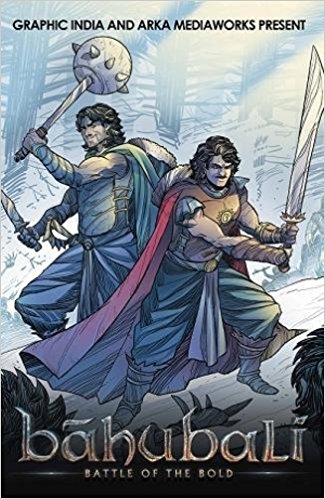
In sync with the sweeping developments, books have hit the market to serve as companions to the cinematic creations.  Two major literary works are “The Rise of Sivagami” by Anand Neelakantan (Westland Publications) and “Bahubali: Battle of the Bold” (Graphic India).


Director of the films S.S. Rajamouli is all praise for “The Rise of Sivagami.”  He says, “I may have brought Sivagami to life on screen, but it is Anand Neelakantan, who has given her wings.”


“Bahubali: Battle of the Bold” is a graphic novel giving people fresh insights into the characters and taking them into a world of new adventures with Bahubali and other pivotal characters.     


Toys and figurines

The Bahubali euphoria has spread to production of toys and figurines as well.

 
Children are going crazy to own and show off swords similar to those used in the movies.  These toy weapons are made of quality plastic incorporating safety features.


Figurines of major characters of the films have been produced, which can serve as show pieces in the drawing room,   Models of Amarendra and Bhalladeva in their full battle outfits are much sought after.


Theme park

Kishkinta, a well-known theme park near Tambaram on the outskirts of Chennai, has introduced a new programme based on the Bahubali concept.  A promotional video promises visitors that the programme will enable them to relive the roles of Bahubali and other actors. 


Jokes

Ever since the first Bahubali flick hit the entertainment world, humour writers have been busy churning out pieces on WhatsApp, Facebook and the rest of the social media.  Sample the following. 


Teacher: Who is the first man to set foot on the moon?
Student: Bahubali.
Teacher: (Angrily) What?
Student: Bahu means ARM and Bali means STRONG. 

***

Amarendra Bahubali did not consume liquor anywhere in the film.  He was killed by Kattappa.
Bhallaladeva also did not touch liquor.  He was done to death by Mahendra Bahubali.
Only crafty King Bhujjaladeva lived till the end.  He was a regular drinker!

***

Neither a bunch of flowers nor any words of endearment will help a young man win the heart of his lover, but surely a couple of tickets to Bahubali.

***

Why did Kattappa kill Bahubali?  This was the teaser at the end of the first Bahubali film.  It was a great marketing strategy.  This has given rise to a plethora of funny reactions.  Here are some:

Kattappa killed Bahubali because the toothpaste that he used had a lot of salt in it!  It made him the most trustworthy slave to his royal bosses.  That is why he executed their orders without asking a question.

A job recruiting agency advertised:  “Don’t be like Kattappa carrying out obediently all orders of your higher-ups in the office.  Kick your job today.  We will get you a better position.”

 A man applied for a day’s leave.  The reason he cited was: “Going to stand in the queue to buy tickets for the Bahubali movie.  My mind will blow off if I do not know by the first show on the first day the reason why Kattappa killed Bahubali.”

***

And the show will go on. Only time will unfold what more Bahubalis can do.


(Ends)
June 06, 2017