Saturday, 13 June 2015

UDAIPUR'S COLOURFUL ATTRACTIONS


THE DIARY OF A TOURIST
(By Subbaram Danda)


A traditionally caparisoned white Mewar steed

Udaipur offers to tourists a colourful mosaic of attractions, besides an exhilarating boat ride on the placed waters of Lake Pichola and a unique opportunity to stay in exquisite palaces-turned luxury hotels.  It provides a rare insight into the lifestyles of the kings of the former princely state of Mewar, now a part of the state of Rajasthan, and the cultural background of its people over the centuries.

City Palace

One major attraction is the City Palace, an enormous white edifice that stretches along the waterfront of the lake.   It encompasses several mansions, courtyards, pavilions, terraces, corridors and halls built over a period of more than three hundred years by successive rulers of Mewar. 

A significant portion of the palace has been converted into a museum, which is what the tourists mostly see today.   In the course of our Rajasthan tour in March 2015, my wife and I spent more than two hours going round it, accompanied by an official guide. 

At the entrance, a huge masonry arch with three large portals greets visitors to the City Palace.  Once through it, we entered the museum.  Inside, on a wall we found a large mural of an elephant charging in a battle field.    Then on we had to wend our way through a labyrinth of pathways and stairwells.

An arch with three portals

Entrance to the City Palace Museum

A mural of a charging elephant
    
Some sights in the palace were fascinating.  The Sheesh Mahal (The Mansion of Mirrors) had reflectors, glass panes and glazed tiles all over its walls and the ceiling in a colourful scheme.  Similarly, a large room used for royal dining displayed a comparable décor.  On the wall of a hall a huge ornamental artwork portraying Sun God glistened gorgeously.  

Sheesh Mahal (The Hall of Mirrors)

Royal dining hall

An ornately crafted image of Sun God

A narrow staircase had on both its side-walls neatly-plastered glazed tiles with floral designs.  Interestingly, it had vertical metallic grab bars at intervals, in addition to regular ones.  At the Mor Chowk (The Peacock Square) we could see artworks on buildings reflecting the peacock theme.  From a courtyard overlooking Lake Pichola, we enjoyed a beautiful view of the “Floating Palace” – the Lake Palace on an island in the lake.  

A staircase with vertical hand-grabs

A building in the Peacock Square

The "Floating Palace" as seen from the City Palace

Among the museum’s collections were old weapons, paintings, artifacts, sculptures, royal paraphernalia and models of animals that served the rulers.    Of interest were a gold-plated howda (seat for a ride on an elephant), a palanquin, a horse-drawn carriage, a model of a caparisoned white horse ready to participate in an official procession and an all- silver cradle for royal children.    

A gold-plated seat for use during elephant rides

Another artistically crafted seat for royal rides

A horse-drawn carriage used by the royalty

An all-silver cradle for royal babies
Chetak

The cynosure of all eyes was, undoubtedly, the life-size model of Rana Pratap Singh’s gallant white steed Chetak.  Its exploits are legendary.  We were told that the horse displayed its incredible valour and loyalty in a battle fought in 1576 against the forces of the Mughal emperor Akbar at Haldighati about 40 km from Udaipur.  Wearing a long mask that resembled the trunk of an elephant, it carried its master Rana Pratap on its back and charged forward.  The mask on a fast-moving horse was intended to confuse the enemy elephants.

CHETAK, the loyal white steed of Rana Pratap Singh.  See the
long mask of an elephant trunk attached to its mouth.

When the Rana decided to take on elephant-riding Man Singh, a Rajput vassal of Akbar and commander of the Mughal forces, Chetak pounced on the elephant and pounded its head with its forelegs to immobilize it.  The Rana threw his lance at Man Singh but he ducked and avoided it.  In turn he threw a sword at Chetak and succeeded in badly injuring its right rear leg.  As enemy forces tried to surround it, the horse galloped out of the battle field on its three legs carrying Rana Prathap and ran for more than five kilometres, saving its master.  Finally on the banks of a stream it collapsed.   At this spot stands a memorial erected by the grateful Maharana for his truly loyal horse.

No tourist can afford to miss the City Palace. 

The Jagdish Temple

A prominent place of worship in Udaipur is Jagdish temple, an architectural splendour dedicated to Lord Jagannath, an avatar of Lord Mahavishnu of the Hindu pantheon of Gods.  The presiding deity is the same as in the famous Jagannath temple at Puri in the state of Orissa.  We saw a large number of people, including many foreigners, visiting the Udaipur shrine. 

The exterior view of the Jagdish Temple

The temple is located close to the main entrance of the City Palace.  Built in 1615 by Maharana Jagat Singh I on a hillock, it can be reached by climbing a flight of 32 steep steps.  The stairway is flanked at the top by a pair of massive elephant statues with their trunks raised in a greeting fashion. The temple rises majestically in tiers with its main tower soaring high at the rear.  All the external walls and the plinth are replete with exquisite bas reliefs of elephants, horses, alligators, musicians, dancers and celestial nymphs.  They are well-preserved.  Inside, ornate halls, carved pillars and painted walls cast a mystic spell on the visitors.  

The temple rises majestically in tiers

Tastefully carved sculptures on the walls of the temple

Another set of sculptures

The sanctum enshrines a magnificent four armed black marble statue of Lord Jagannath in the standing posture.  There are also idols of Lord Krishna and Goddess Mahalakshmi.   During the times of worship, sacred chants and chimes of bells emanating from there can be heard all over the temple premises.  Around the main shrine there are four smaller ones dedicated to Lord Ganesh, the Sun God, Goddess Shakti and Lord Shiva.

The Jagdish temple is undoubtedly a grand icon on the skyline of Udaipur. 

Eklingji

It is an ancient temple complex located 22 kilometres north of Udaipur.  Within its high walls there are 108 shrines.  The main temple, dating back to the 15th century, was rebuilt on the ruins of an earlier one.   It is dedicated to Eklingji, a form of Lord Shiva, believed to be the presiding deity of the Mewar rulers. 

The high outer wall of the Eklingji temple
 
In the sanctum the image of Lord Shiva appears as a linga with four faces.  It is made of black marble.  The temple features an enormous double-storyed elaborately pillared hall under a vast pyramidal roof.  Facing the main sanctum is a life size idol of Nandi, the bull mount of the Lord. 

Nathdwara

It is a 17th century temple dedicated to Lord Krishna, known locally as Lord Shrinath, located about 50 kilometres from Udaipur. We were told that it is one of the richest shrines of India and attracts millions of devotees from all parts of the country every year.  The magnificent black marble image of the lord enshrined in the sanctum is believed to be over 600 years old and was brought here from Govardhan Hill near Mathura in 1669 in a bid to protect it from the fanatic hands of Mughal emperor Aurangzeb. According to a legend, the place where the temple came up was the site where the chariot carrying the idol got stuck and this incident was interpreted as the divine direction not to move it anywhere else.  

From the point where our car was parked, we had to walk a long distance through narrow lanes flanked by small shops before reaching the main temple.  People thronged it and we had to wade our way inside for darshan.  The security was tight and foreigners were not permitted inside.  Photography was prohibited.

Sahelion ki Bari

Sahelion ki Bari (The Garden of the Maidens) is another tourist attraction to the north of Udaipur.  The garden was designed and raised by Maharana Sangram Singh in the 18th century.  It was presented to his queen to be used by the 48 young companions she had brought with her as dowry.  It was a place of pleasure and relaxation for the royal maidens.   Vast lawns, flower beds, ornamental trees, pools, ponds, fountains, paved walkways and huge portals enrich the beauty of the garden.  Raised on the banks of the Fatesh Sagar Lake, its fountains function through water-pressure coming from it and no pumps are used.

A doorway at the Garden of the Maidens 

The neatly-tended lawns, bushes and trees

Another view of the garden

“Udaipur is a jewel among the cities of Rajasthan” -- this is how our tourist guide described it and we have no reason to dispute his claim.  (Ends)

June 13, 2015


Saturday, 30 May 2015

THE JODHPUR POTPOURRI


A TOURIST'S MISCELLANY
(By Subbaram Danda)


The front view of the memorial in Jaswant Thada

Apart from the Mehrangarh fort (the Citadel of the Sun), Jodhpur in Rajasthan has several other tourist attractions.  They may not be as great as the fort but they do have their own unique charm, as my wife and I found out during our tour of the city in March 2015.  

Jaswant Thada

One of them is Jaswant Thada, a beautifully landscaped complex housing a royal memorial and several cenotaphs.  Named after Maharaja Jaswant Singh II of the former princely state of Marwar, it was conceived and developed by his son Maharaja Sardar Singh.  

The grand complex, artistically planned with lawns, pathways and flower plants, is situated about one kilometre downhill from the Mehrangarh fort.  The all-marble memorial, completed in 1906, has a dazzling tower, ornate columns and well-designed corridors that captivate every visitor.  Often it is described as the “Taj Mahal of Marwar.”  Inside the memorial there are portraits of the successive rulers of Marwar and a complete genealogical table of the royal family.   The cenotaphs, also built in marble, are flat-roofed.  They are of Jaswant Singh, four other kings and two queens.  

Entrance to Jaswant Thada

Close-up of the memorial

Interior of the memorial

Some cenotaphs

The memorial seen from another angle

Umaid Bhawan Palace

Another place of interest for tourists is a palace sprawling over 26 acres on a high terrain built by Maharaja Umaid Singh between 1929 and 1942.  Called Umaid Bhawan Palace, it also resembles the Taj Mahal.  It is said to be the only palace to have been constructed in the 20th century.  One of its special features is that it was erected with hand-chiselled sandstone blocks put in place through an interlocking system eliminating the use of binding mortar.  The imposing central dome of the palace rising to a height of 170 feet has a whispering gallery underneath. 

The history of construction of this palace is fascinating.  It was taken up as a famine-relief project to provide jobs to many poor people.  A special railway line had to be laid for a length of 10 kms to transport sandstone to the site.  A workforce of about 3,000 toiled for 15 years to complete it. 

Unfortunately, general visitors will not be able to appreciate this “spectacular palace” fully.  A residence for the royal descendants and a luxury hotel have together taken up a large portion of the palace and so that space is out of bounds for ordinary tourists.  Worse, even a vast chunk of the garden in the front has been cordoned off.  

However, open to the public is a museum in a relatively small area that displays royal portraits, artefacts, weapons, clocks, crockery, models of aeroplanes and hunting trophies.  We completed going round this area in less than half an hour.  Within the compound, in an enclosed area away from the palace, one can see a display of vintage cars. 

The façade of the Umaid Bhawan Palace

The 170-foot high central dome of the palace

A garden in the front

The vaulted roof of an interior hall

An open courtyard

The entrance to the luxury hotel

The Mandore Garden

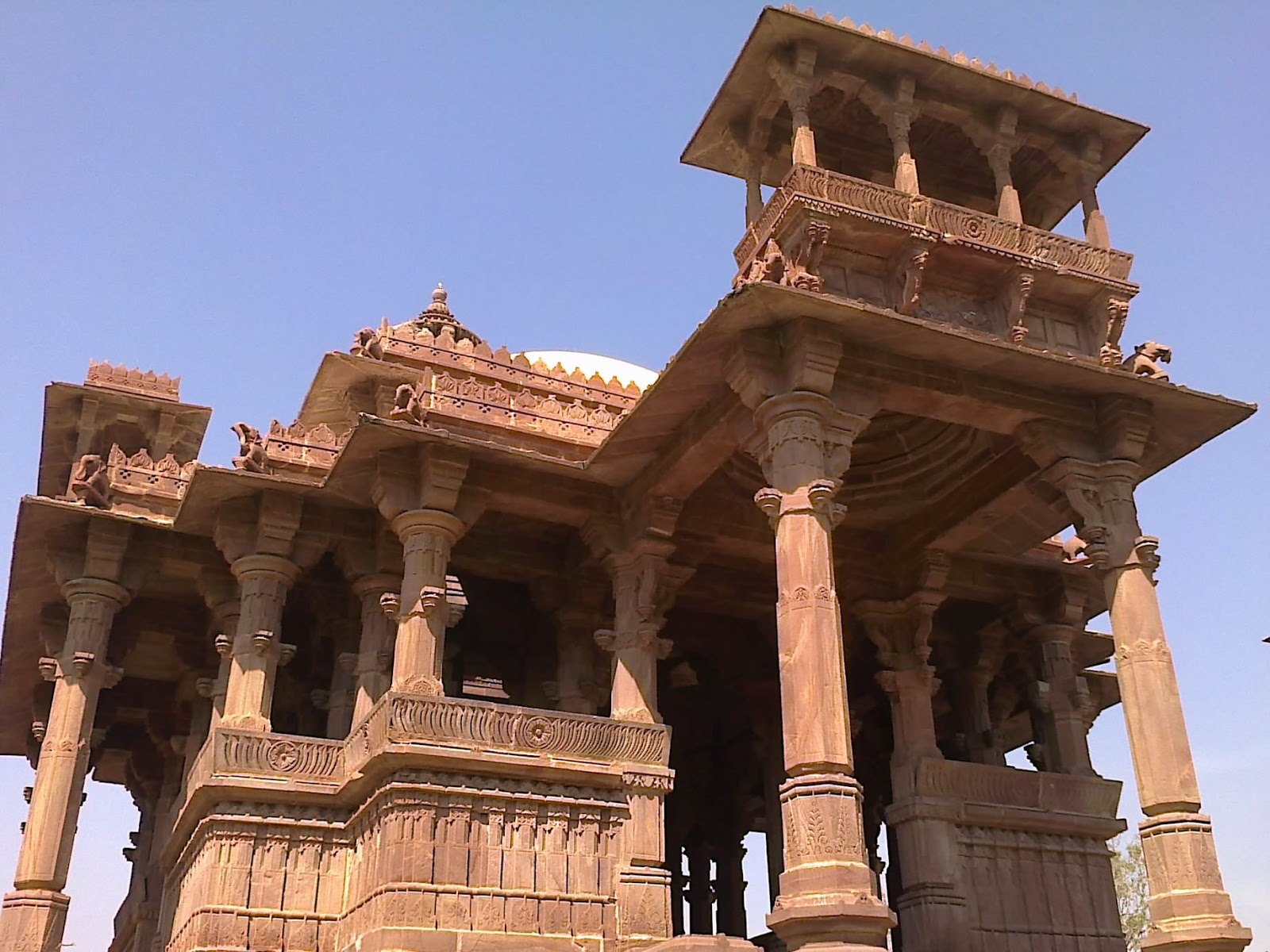
Further, tourists can explore Mandore, a town located eight kilometres north of Jodhpur. It was the capital of Marwar before it was shifted to Jodhpur.  Inside a vast garden in the town there are several red sandstone memorials and cenotaphs of many past rulers.  Most of them are in good condition and they stand out.  The memorials resemble temples, as the kings of those days were regarded as divine beings.  The cenotaphs look like cupolas on pillars.  From the gate one has to walk some distance to reach the point of these temples.  Monkeys provide company to the visitors!
 
Another attraction in the garden is “The Hall of Heroes.”  Sixteen gigantic figures of Hindu deities and folklore chieftains can be seen chiselled one after another horizontally on the side of a cliff.  They have been painted in bright colours or in white. 

A temple-like memorial for a Marwar king

Another memorial designed differently

A multi-tiered memorial with a cenotaph

Interior of a memorial

Sculptures on pillars and walls of a memorial

A long-shot of "The Hall of Heroes" on a cliff side

Close-up of sculptures in "The Hall of Heroes"

With a few more attractions, Jodhpur is a variegated treasure-house for history buffs and archaeologists.  Photo opportunities are, of course, aplenty.  (Ends)

May 30, 2015


Saturday, 25 April 2015

A MARVEL IN MARBLE


THE JAIN TEMPLE AT RANAKPUR
(By Subbaram Danda)


We stood stunned, looking at the magnificent façade of the Jain temple at Ranakpur.  It was a spectacle.  The marble edifice shimmered gorgeously in the mid-day sun.  The long flight of steps leading to its main entrance, the porches in three tiers, the rows of towers and the central dome at the top provided a delectable treat to the eyes.  We had read a lot about this abode of worship but what we actually saw surpassed all those accounts.  We were gazing at an exquisite sanctuary of spiritual art.


The front view of the temple

We – my wife and I – were visiting the Jain temple on our way from Jodhpur to Udaipur in the course of our Rajasthan vacation in March 2015.  It was an important item on our itinerary.  Ranakpur is located at about 165 kilometres south of Jodhpur and about 90 kilometres north of Udaipur. 

The temple seen from another angle

A pious Jain businessman constructed the temple in the 15th century following a vision he had.  In this effort he received the patronage of the liberal king of Mewar, Rana Kumbha.  It came up in a valley on the western side of the Aravalli range of mountains.  Renovated from time to time, it stands on a basement of 48,000 sq.ft.

The temple is dedicated to Rishabhadev, the first of the 24 Jain Tirthankaras.   A Tirthankara is a “liberated being”, who has severed all earthly bonds, crossed the stream of rebirths and attained the status of the omniscient.  He guides others on the path of renunciation and emancipation.  Rishabhadev, being the first, is also known as Adhinath (the first Lord).  The temple is one of the five major pilgrim centres of the Jains.

The massive temple has four separate entrances, one in each of the cardinal directions.  All of them lead visitors, through columned halls, to a central arena and finally to the sanctum.  In it there is a four-faced marble image of Lord Rishabhadev.  The sanctum is surrounded by several smaller shrines.   One more line of cells with holy images encircles these shrines.  Towers and domes rise above these shrines and cells.   

As we walked up the steps and passed through the main portal of the temple, a vista of architectural splendour unfolded before us.  We stood in a spacious high hall, where pillars, pedestals, capitals, lintels and the domed ceiling displayed intricately sculpted floral designs, animal motifs, celestial figures, dancing nymphs and geometrical patterns.  We saw many foreign visitors listening intently to guides, who waxed eloquent on the special characteristics of the temple.  They looked at every piece of artwork in awe. 

The ornate pillars, pedestals, capitals and lintels as seen from the front high hall

The intricately chiselled designs on pillar capitals and the ceiling 

The sculpted embellishments on a ceiling under a dome

Far ahead of us was the sanctum, where worship was going on for the principal idol of Rishabhadev amidst the chanting of hymns.  Many devotees thronged the assembly hall in front of it.  We offered our prayers from a distance and moved on. 

Hall after hall and corridor after corridor presented a variety of creative carvings.  In all, we were told, the temple has 29 halls, 80 domes and 1,444 pillars.  What is awe-inspiring is the fact that each pillar is unique in design and each dome’s ceiling is different. This feature offered us plenty of photo opportunities and we clicked liberally.  Only the idols of worship were not to be photographed. 
  

Each of the 1,444 marble pillars in the temple is different in structure and design

Animal motifs and geometrical patterns enliven the temple

Celestial figures and dancing nymphs on pillars

Within the temple complex we could see several open courtyards, which would allow sun rays to penetrate the temple, illuminating its interiors.   A significant effect of it is the wonderful play of light and shade on the pillars. As the rays shift through the day the pillars appear to change their colour from pale yellow to light gold. 
  

A tower as seen from a courtyard
  
Among other noteworthy features were two big bells placed near the sanctum.    Along a corridor a wall displayed an image of 23rd Tirthankar Parshwanath.  It was enclosed within an intricately carved band of flowers, mermaids, snakes and knots.  Elsewhere we came across life-sized marble elephants standing at the centre of small halls. 


The circular image of 23rd Tirthankar Parshwanath

An elephant in marble

Posing with another elephant statue amidst sculpted pillars

As we kept going, it was not hard to realize that the entire temple is a treasure trove of spiritual art.  An elderly woman from the US, who struck a conversation with us, was exuberant in her praise of the temple.  She did not mince words when she said, “I have not seen such a wonder in my life so far.  Every element here is a masterpiece.”  We could not but be in agreement with her.  What we were witnessing was poetry in stone.  

(Ends)

April 25, 2015


Saturday, 11 April 2015

ON THE TRAIL OF JAMES BOND


IN ROMANTIC UDAIPUR
(By Subbaram Danda)


A view of Udaipur

As my wife and I entered Udaipur in the course of our Rajasthan tour in March 2015, driving on its crowded narrow streets, a huge board of a hotel caught my attention.  The last line on it read in bold letters, “We show James Bond film Octopussy every evening at 7 p.m.”  For a moment I was intrigued.  Why should the film be run by the hotel and that too every day?    Soon some more similar hotel boards with the same text confronted me. 

Suddenly I recalled what I had read in travel books and on the internet.  Almost the entire film Octopussy had been shot in Udaipur.  Many tourist sights of the city can be seen in the widely popular film.   And several of these attractions were there on our itinerary too.  The hotels were trying to attract foreign tourists by showing the film to them and offering to take them to those sites.  Excellent marketing strategy!

I am an ardent fan of Ian Fleming, the author of James Bond thrillers.  For the uninitiated, James Bond is the lead character in the novels -- a British spy with the authority to kill.  His code is 007.  I have read almost all Bond novels.  Naturally I also love the films produced on the basis of the novels. 

Octopussy is the 13th Bond film starring Roger Moore in the main role.  Though the title is borrowed from Ian Fleming’s work, the film plot is vastly different.  

In the film, Bond is assigned the task of unravelling the international ramifications of the theft of invaluable relics from the Soviet Union. The trail leads him to Udaipur, where the operatives have set shop.

Octopussy is the name of a wealthy woman accomplice of an international smuggler involved in the theft.   Swedish-born bewitching American actress Maud Adams plays this role.  She resides in two palaces – Lake Palace and Jag Mandir Palace – each built on an island in Udaipur’s famous Lake Pichola.  James Bond stays in another palace -- the luxurious Shiv Niwas Palace Hotel on the banks of the lake.  

Lake Palace, now a luxury hotel

Exterior view of Jag Mandir Palace

Shiv Niwas Palace Hotel

Lake Palace, built by Maharana Jagat Singh II in 1754, has been converted into an expensive private luxury hotel. Its lush pools, lavish suites, stunning pavilions and dreamy fountains came in handy for the film maker to add glitz and glamour to the flick in abundance.

Jag Mandir Palace was put up by Maharana Karan Singh in 1620. Its neatly-tended gardens, open court yards and above all life-size statues of elephants at the entrance and elsewhere are a sight to behold.  The film exploits these to the full extent. 

An open courtyard of Jag Mandir Palace

In the courtyard of Jag Mandir Palace

A garden in Jag Mandir Palace

Elephant statues in the garden of Jag Mandir Palace

Incidentally, Jag Mandir Palace has an interesting tale to tell.  Mughal Prince Khurram, who later came to be known as Shah Jahan, had a dispute with his father and this forced him to seek refuge with the then ruler of the Kingdom of Mewar at Udaipur.  Subsequently Khurram stayed at Jag Mandir Palace.  He was reportedly overwhelmed by Udaipur palaces all around and wanted to build such edifices himself, if he had an opportunity.  This inspiration eventually led to the construction of the world famous Taj Mahal in memory of his wife Mumtaj.

Shiv Nivas Palace, completed by Maharana Fateh Singh at the beginning of the 20th century, served as a royal guest house.  Among the world celebrities it hosted was King George V of the United Kingdom.  It was later turned into a luxury hotel.   

Our programme in Udaipur included a boat ride on the placid waters of Lake Pichola with a halt at the Jag Mandir Palace.  In the film James Bond also sails on the lake frequently.  Our ride enabled us to have a look at all the palaces from our boat and also provided an opportunity to step into Jag Mandir Palace, which is currently a resort with yoga and meditation facilities.  Weddings and other events also take place there.  

Boat ride on Lake Pichola

In the boat

Our hotel room in Udaipur was lake facing and we could comfortably see boats on the lake pass by.  Exactly opposite to our room across the lake on the other side was a ghat and an open paved area.  One evening we could see colourfully-dressed Rajasthani women come in a procession and gather there.  Several women carried images of Issar and Gangaur, manifestations of Shiva and Parvati.  Music, dance and other cultural programmes followed.  We learnt that it was a festival gathering to welcome the Spring season.  Several special boats with music bands and dancing youngsters sailed past the place on the lake. 

A view of Lake Pichola from our hotel room

Boats participating in the Spring festival

The Octopussy film too has a similar event shot at the same place, where James Bond was received.   The film incorporates many other scenes of the city in abundance – street-side shops selling a variety of wares, autorickshaws weaving through crowded lanes, women in colourful saris moving around and children playing in gay abandon.   Tennis player Vijay Amritraj plays the role of a companion of Bond in the film.

Udaipur finds a place not only in Octopussy but also in several other international and regional films.  Citizens of this city are proud of not only their heritage and culture but also the fact that it continues to attract film producers from all over the world.  

We did not stay in Hotel Lake Palace or Shiv Niwas Palace Hotel, as they were highly expensive, and so their interiors could not be caught by our camera.  However, we were able to capture in our photographs several of the sights featured in Octopussy, as if we had been on James Bond’s trail! 


April 11, 2015